01 · Quiet
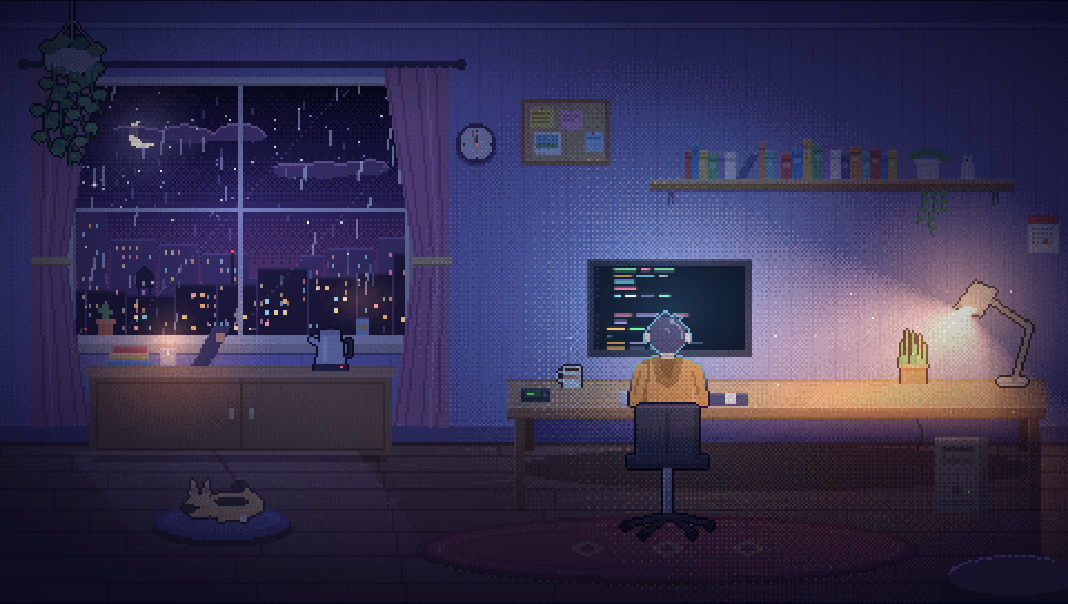
The room is calm.
Rain, a lamp, a mug. Pebble & Pine is a fictional home-goods marketplace, and tonight you are the on-call engineer.
on-call · night shift · rain
A lo-fi developer incident game
Learn software engineering by surviving production.
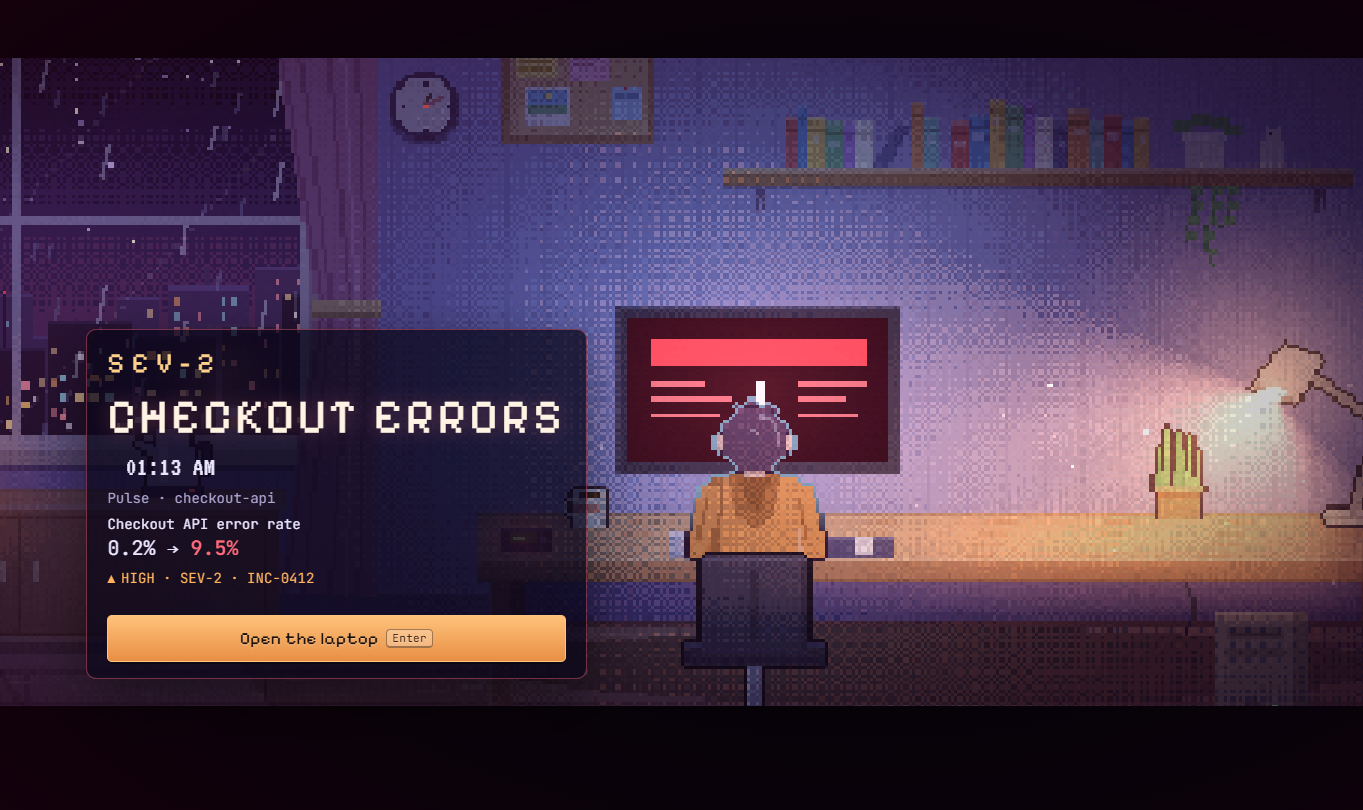
The night · 01:13
01 · Quiet
Rain, a lamp, a mug. Pebble & Pine is a fictional home-goods marketplace, and tonight you are the on-call engineer.
02 · Page
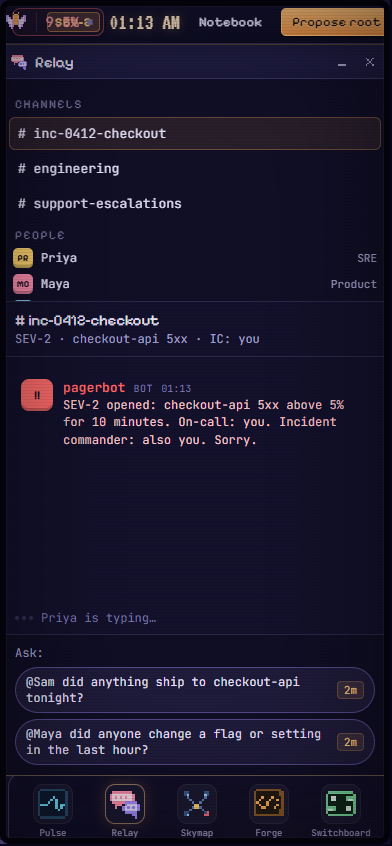
A monitor flips. Customers are stuck. Someone in Relay is already sure they know why.
03 · Evidence
Logs, traces, flags, deploys. The notebook keeps facts. Opinions stay opinions until the system agrees.
04 · Recovery
A mitigation stops the bleeding. A real fix is the change you would still defend in the morning.
05 · After
Engineering Lab is the other half of the night: design a system, send traffic, break it, and see why.
Workstation · healthy
Logs are noisy. The dashboard is green. Customers disagree. Find what actually happened.
Error rate0.8%healthy
0.2%
HEALTHY
The dashboard is green.
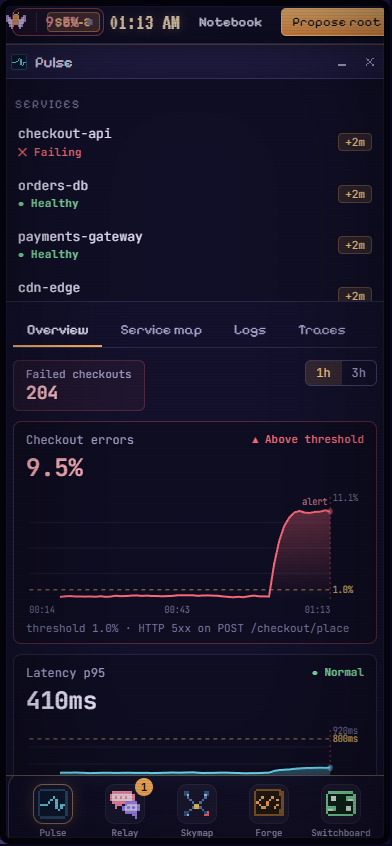
Health, graphs, logs, traces. Green is a color, not a conclusion.
Team chat. People have theories. Theories are not evidence.
Feature flags and runtime config. A lot of flags start with TEMP_.
What shipped, and when. Timing is a clue, not a verdict.
The facts you have actually earned, plus the hypothesis you are willing to test.
Services, dependencies, owners. Symptoms live here. Motives do not.
A local assistant. It names a tool, then separates confirmed, likely, and unknown.
Notebook
Each night has a real root cause, an evidence chain, and at least one thing that looks guilty and is not.
You are investigating a system, not guessing a quiz answer.
Engineering Lab
Blueprint is a small architecture you can actually run. Traffic goes up. The queue rises. Latency follows. Then you change the drawing.
Queue is hot. Latency follows. Change the drawing and run it again.
Tracks · System Design
These are interactive scenarios. There is no lecture track, no certificate, and no claim that a night shift replaces the job.
Shape a path, then watch traffic move through it. A cache is a decision, not a sticker.
Retries, duplicates, ordering, and the charge that may have already happened.
How a request should behave. Not how to spell JSON.
Scale, regions, and rollouts, without a vendor logo quiz.
Alerts, deploys, and the difference between a graph and a customer.
Agents, retrieval, tools, cost, and evals. Still just software.
Wick // online
Players practice agents that call tools, retrieval that can be stale, and a bill that arrives because a loop did not stop.
Pebble & Pine · internal
Change hair, clothes, and glasses. Companions are company, not the job. Luna sleeps near the desk until the room stops being quiet.
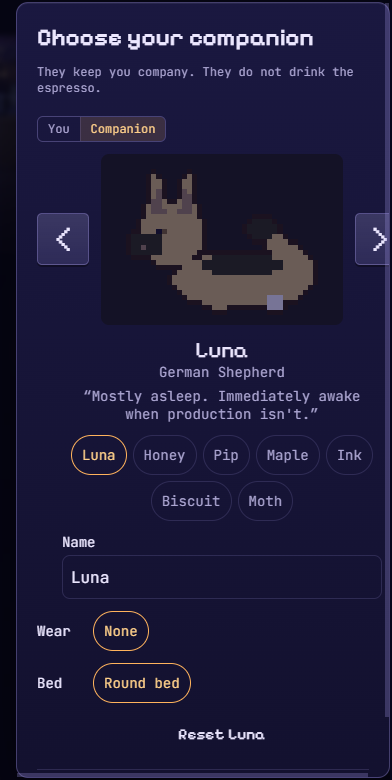
German Shepherd
Mostly asleep. Immediately awake when production isn't.
Golden Retriever
Treats every quiet minute like you just got home.
Corgi
Patrols the rug. The rug has accepted this.
Beagle
Follows footsteps. Dashboards are a distant second.
Black Cat
Keeps the window seat. The rain can have the rest.
Tabby Cat
Desk-adjacent. On-call was not in the job description.
Tuxedo Cat
Dressed for the night shift. Does not take the pager.
Public alpha
The public release is a real slice of the game, not the whole campaign.
Production is a testing environment. Apparently. The public build does not pretend otherwise.
PLAY FREEReleases
More incidents and labs will arrive in content drops. There is no published calendar.
Now
Nights 1 and 2, a daily incident, a quick shift, and sample labs. This is the build you can play.
Later
A larger campaign already exists. It will arrive in episodic drops, along with more labs. No schedule is published.
Preview
Private preview testers may receive full-build access. There is no public signup on this site. If you were invited, the game itself is where that access lives.
Capture Mode
The game can record a quiet room, an incident, and the lab. This spot plays that reel when one is published.
Rain on the glass. The lamp is the warmest thing in the building.
Pulse is loud. The dashboard is not the incident.
Draw the path. Add traffic. Watch the queue admit what the diagram hid.